Hidden Historical Sites: What Ancient Civilizations Never Wanted You to Find (2025 Guide)
Image Source: Unsplash - Toa Heftiba
Image Source: Unsplash - Stacey Franco
Image Source: Unsplash - Willian Justen de Vasconcellos
Ancient civilizations left behind more than just the historical sites we all know. While the Pyramids stand as the last remaining Wonder of the Ancient World, many fascinating locations remained hidden for centuries. Machu Picchu, for instance, was never discovered by the Spanish due to its remote location, only to be rediscovered in 1911 by Hiram Bingham.
In our exploration of lesser-known historical sites in Greece, Rome, and beyond, we'll venture beyond the tourist hotspots. Egypt and Mesopotamia represent some of the oldest civilizations on Earth, with the latter being the very cradle of human civilization between the Tigris and Euphrates rivers. Despite their significance, many historical sites in Italy and historical sites in Rome remain unexplored by average tourists. In fact, Mesopotamia historical sites showcase early writing, mathematics, and astronomy developments that shaped our world.
The appeal of these hidden wonders is undeniable. However, the most rewarding discoveries often lie just beyond the familiar landmarks—whether you're searching for historical sites near me or planning an international adventure to uncover ancient secrets that have remained hidden for millennia.
Planning your historical adventure? Use our fuel cost calculator to estimate travel expenses between archaeological sites, and our budget calculator to plan your entire historical exploration trip within your budget.
Lost Cities of Mesopotamia
"From the ziggurat as far as the eye can see there is naught but awful solitude; you look down on somber desert which encircles you for miles." — Thompson, Archeological observer of ancient Mesopotamian sites
Beneath the sands of Iraq lie cities older than written history itself. Mesopotamia's ancient metropolises once bustled with life thousands of years before Rome was founded. These settlements weren't just villages—they were sophisticated urban centers with complex religious structures, administrative systems, and cultural practices that shaped humanity's earliest civilizations.
The forgotten ziggurats of Eridu
Deep in southern Iraq stands Eridu, traditionally considered the earliest city in Mesopotamia according to the Sumerian King List. Founded around 5400 BC, Eridu initially stood near the Persian Gulf, though it now lies approximately 90 miles inland. When Iraqi archeologist Fuad Safar and British archeologist Seton Lloyd began large-scale excavations in 1946, they discovered an architectural marvel: eighteen superimposed mudbrick temples built one atop another over millennia, culminating in an unfinished ziggurat from the 21st century BC.
What makes Eridu particularly fascinating is its virgin foundation—excavations revealed the city was built on a previously uninhabited sand dune. As researchers dug beneath the ziggurat, they uncovered increasingly ancient layers, including remains from the pre-Sumerian Ubaid period (5300-3800 BC).
Furthermore, the city's religious significance endured remarkably long—Eridu preserved its urban identity for nearly five millennia before finally ceasing to function as a recognizable city around 600 BC. The repeated reconstruction of the temple of Enki, dedicated to the water deity, demonstrates how sacred spaces evolved from household worship to grand institutional religion.
Why ancient Sumerian texts remain untranslated
Though archeologists have unearthed hundreds of thousands of cuneiform tablets from Mesopotamia's ruins, many still remain untranslated. This translational bottleneck exists for several compelling reasons:
- The time-intensive nature of translation requires specialized expertise
- Only a few hundred qualified experts worldwide can perform this work
- The sheer volume of discovered tablets overwhelms available resources
These clay documents hold the political, social, economic, and scientific history of ancient Mesopotamia. Many tablets have been digitized online, yet the knowledge they contain remains locked away. Each tablet potentially contains insights about the first civilizations' daily life, governance structures, and belief systems—information that could transform our understanding of humanity's earliest urban societies. Recent advances in AI translation of cuneiform are helping accelerate this process.
Mesopotamia historical sites still under excavation
Active archeological work continues across the region, with new discoveries regularly reshaping our understanding. At Kurd Qaburstan in northeastern Iraq, researchers have uncovered what may be the ancient city of Qabra, a regional power center mentioned in Old Babylonian monuments from around 1800 BCE. The site's importance became even clearer when archeologists discovered cuneiform tablets—the first such finds in this part of northern Iraq.
Similarly, a 4,000-year-old lost city near Sulaymaniyah in Iraqi Kurdistan revealed flour offices, tools made from rare stones like obsidian and carnelian, and evidence of sophisticated agriculture with irrigation networks. Additionally, the search continues for Agade, birthplace of the Akkadian Empire and considered the first ancient Mesopotamian empire. Historians believe it was located between Baghdad and Samarra, though the changing course of the Tigris River over millennia may have washed away its remains.
The political stabilization of northern Iraq has recently allowed researchers to access previously unavailable sites. Before 2003, Saddam Hussein's regime limited archeological access, followed by further disruptions during ISIS's presence. Today, international teams use advanced techniques like magnetometry to map buried structures across vast areas without excavation—revealing palaces, temples, and entire street networks hidden beneath seemingly empty plains.
Hidden Temples of Ancient Greece
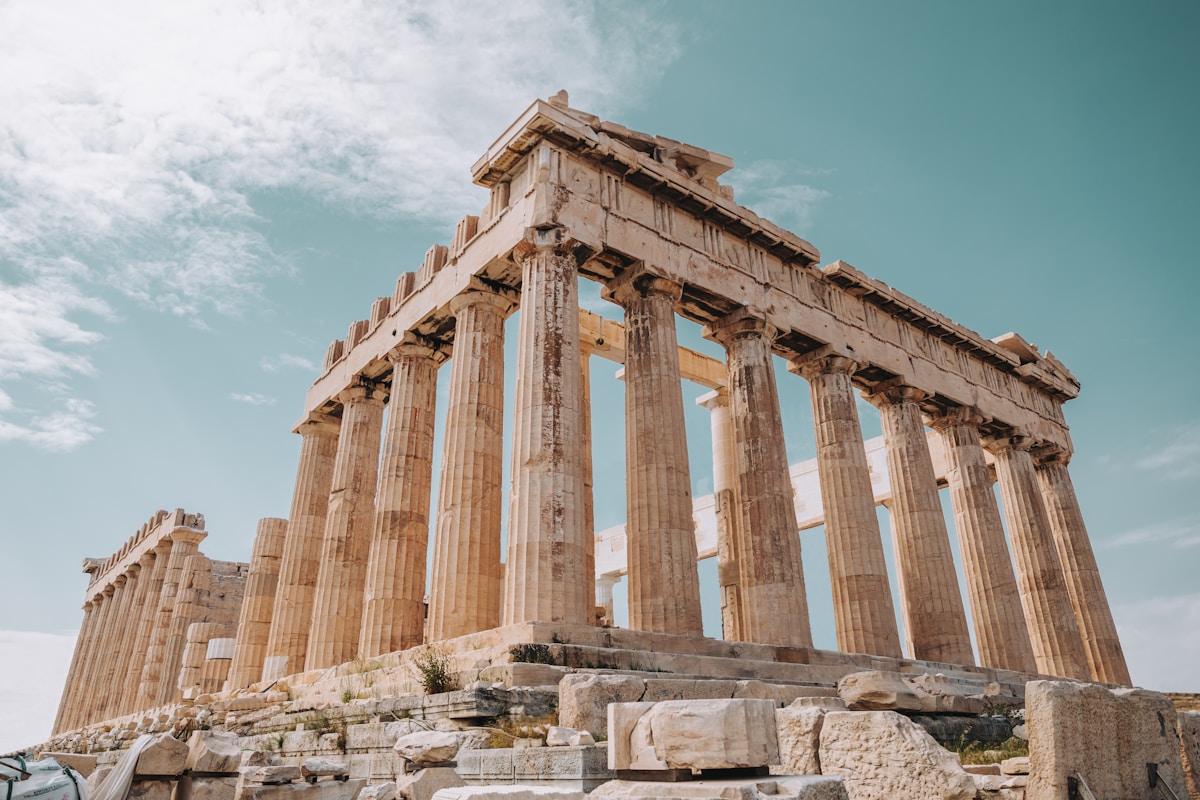
Image Source: Unsplash - Spencer Davis
Greece's mainland hides sacred spaces that even history enthusiasts often overlook, with ancient sanctuaries tucked away from mainstream tourist paths. These secretive temples once housed rituals so mysterious that divulging their details was punishable by death.
The underground sanctuary of Eleusis
Just an hour from Athens lies Eleusis (modern Elefsina), once considered one of the most important religious centers in antiquity. The sanctuary's heart was the Telesterion, an almost square hypostyle hall measuring approximately 51.50 meters per side, where the famous Eleusinian Mysteries took place. This building featured:
- Six rows of seven columns supporting a roof with an elevated lantern/clerestory for ventilation and light
- Rows of seating lining the inner walls, interrupted only by doorways
- Multiple entrances providing access to the interior, where nocturnal rites occurred
The most fascinating aspect of Eleusis was undoubtedly its Mysteries—an initiation ceremony dedicated to Demeter and her daughter Persephone, associated with vegetation, fertility, and the regeneration of nature. Consequently, what actually happened inside remained secret for centuries. As Plato alluded, initiates experienced "perfect and simple... and calm and happy apparitions, which we saw in the pure light".
Lesser-known ruins near Delphi
Although most travelers flock to Delphi's Temple of Apollo, they often miss the Temple of Athena Pronaia located just outside the main archeological site. This temple remains in much better condition than many other ruins in the area and offers visitors space to explore without the crowds. Moreover, as you climb the Sacred Way, you'll discover numerous foundations of buildings that once held offerings to Apollo—evidence of how crowded this sacred place must have been with structures showcasing the power of Greek city-states.
Historical sites in Greece beyond the Acropolis
Eastern Attica, about 35km from Athens, houses Brauron (modern Vravrona), a sanctuary of Artemis featuring a constellation of smaller, deeply evocative ruins. Notably, this site was one of Attica's original twelve cities, showing signs of habitation back to the Neolithic period.
Farther north, Rhamnous rewards determined visitors with one of the most atmospheric ancient "demes" in Attica, featuring twin Doric temples dedicated to Nemesis and Themis. The site unfolds over two terraces: a lower sanctuary and an upper acropolis.
On Crete, Eleutherna bridges the island's mythical and historical worlds. Unlike the famous Minoan palaces, Eleutherna flourished later during the Geometric, Archaic, and Classical periods. Excavations have revealed sanctuaries, paved streets, cisterns, and early Christian basilicas scattered along the slopes.
Perhaps most impressive is Messene in the Peloponnese—one of Greece's most complete ancient cities yet always uncrowded. Founded in 369 BC after Sparta's defeat, it features massive defensive walls, religious centers, a theater, stadium, and even residential quarters preserved in situ.
These sites offer authentic glimpses into ancient Greek life without the overwhelming crowds that dominate more famous historical sites in Greece.
Traveling between Greek ruins? Calculate your transportation costs with our fuel cost calculator to plan efficient routes between archaeological sites.
Buried Secrets of Rome
"King Ur-Nammu rebuilt and enlarged one of the most important temples in ancient Mesopotamia – the E-kur of Enlil, the chief god of the pantheon." — Katachriston (scholarly source), Academic analysis of ancient Mesopotamian temple construction and royal patronage
Rome's ancient secrets lie not just around the city but directly beneath it, with layers of history stacked below modern streets. Beneath the Eternal City's bustling surface exists a hidden world where ancient cults worshiped, early Christians buried their dead, and ordinary Romans lived their daily lives.
The Mithraeum beneath San Clemente
Just a few blocks from the Colosseum stands the Basilica of San Clemente, a 12th-century church concealing a remarkable time capsule. Descending beneath the main floor, visitors discover a perfectly preserved 4th-century church. Yet this represents merely the middle layer of this historical site in Rome.
Venture deeper and you'll emerge into a 1st-century Mithraeum—a temple dedicated to the mysterious cult of Mithras. The sanctuary's central hall measures approximately 9.6 meters long by 6 meters wide. Its most striking feature is an altar depicting the tauroctony—Mithras slaying a bull—alongside torch-bearers Cautes and Cautopates. This sacred space once featured a barrel vault ceiling decorated with stars, symbolizing the cosmos central to Mithraic belief.
Catacombs and crypts hidden under Rome
Rome boasts 63 known catacombs, stretching for hundreds of kilometers beneath the city's outskirts. These underground burial chambers originated because Roman law prohibited burying the dead inside city walls.
The Catacombs of San Callisto contain roughly half a million Christian remains, including 16 early popes. Meanwhile, the less-visited Catacombs of Santa Priscilla, known as the "Queen of the Catacombs," feature spectacular Early Christian art, including what many interpret as the oldest image of the Virgin Mary, dating to the 3rd century.
Perhaps most macabre is the Capuchin Crypt, where bones from nearly 4,000 friars were arranged into elaborate decorative patterns. Unlike the catacombs, this crypt seems built from the bones themselves, with remains covering walls from floor to ceiling in artistic designs.
Historical sites in Rome that tourists miss
Even avid visitors often overlook the Crypta Balbi, an excavation site and museum occupying an entire city block. Built on the remains of the Theater of Balbus (13 BC), it clearly displays Rome's historical layers from antiquity through medieval times.
Equally fascinating is the ancient apartment complex beneath the Temple of Claudius on the Caelian Hill. Explorers descending 25 feet underground discover a Roman insula (apartment building) that housed poor residents during the second century AD.
These subterranean treasures provide a three-dimensional timeline of Rome's evolution, revealing historical sites in Italy untouched by mass tourism but crucial to understanding how ordinary Romans lived, worshiped, and died throughout the centuries.
Unseen Wonders of Ancient Italy
Italy's forgotten treasures often lie in plain sight yet remain invisible to typical tourists. Beyond the celebrated attractions, the Italian peninsula harbors historical sites that tell equally compelling stories of civilizations past—places where time stands still.
Italy historical sites not on the tourist map
Off the Campanian coast lies the underwater archeological park of Baia, once an exclusive resort town for Rome's elite. As centuries passed, coastal erosion and volcanic activity submerged over half of this ancient city beneath the Mediterranean. In southern Italy's Magna Graecia region, breathtaking archeological treasures remain frequently overlooked. The majestic Temple of Hera at Tavole Palatine stands as testimony to Greek settlers who arrived in the 7th century BC. Nearby, Metaponto reached its intellectual peak when none other than Pythagoras spent his final years there. Eleutherna on Crete bridges the island's mythical and historical worlds, flourishing during the Geometric, Archaic, and Classical periods with sanctuaries and paved streets scattered along its slopes.
The ghost city of Craco
Perched dramatically on a hilltop in Basilicata, Craco stands frozen in time—a medieval town completely abandoned in the 1960s due to devastating landslides. Founded in the 8th century BCE, this once-thriving settlement now presents crumbling buildings and empty streets offering glimpses into a vanished world. Its cinematic beauty has made it a popular filming location, specifically for Mel Gibson's "The Passion of the Christ". Currently uninhabited, this haunting ghost town draws a small but steady stream of visitors each year. Since 2010, Craco has been included on the World Monuments Fund's watch list.
Etruscan tombs hidden in the hills
North of Rome, the Necropolis of Cerveteri reveals an entire underground city of tombs dating to the 9th century BC. What makes this UNESCO World Heritage site extraordinary is how it mirrors the layout of an actual city, with streets and neighborhoods—all for the dead. In contrast to its importance, Cerveteri receives only around 80,000 visitors annually. At nearby Tarquinia, approximately 6,500 tombs have been identified, with about 200 featuring painted decorations. These vivid frescoes depict scenes from daily life, religious rituals, and mythology, providing rare insights into the enigmatic civilization that significantly influenced the Romans.
Planning a multi-city Italian historical tour? Our budget calculator helps you allocate funds for accommodations, entrance fees, and transportation between sites.
Inca Mysteries Beyond Machu Picchu
Venturing beyond Peru's iconic Machu Picchu reveals Inca engineering marvels that continue to puzzle modern experts.
The secret tunnels of Sacsayhuamán
Researchers recently confirmed what locals had long suspected—a network of ancient tunnels runs beneath Cusco, Peru. These passages, known as Chincanas ("labyrinth" in Quechua), connect the Temple of the Sun to the Sacsayhuamán fortress approximately a mile away. After a twenty-year search guided by 16th-century Spanish accounts, archeologists used ground-penetrating radar to map this underground marvel. The mile-long tunnel measures about 8.5 feet wide and just over 5 feet tall. Built by digging a ditch, lining it with stone walls, and covering it with wooden beams, these passages likely served ceremonial purposes alongside practical communication functions.
Choquequirao: The other lost city
Often called Machu Picchu's "sister city," Choquequirao sprawls across a mountainside overlooking the Apurímac River at 3,050 meters above sea level. Yet this site covers an area three times larger than Machu Picchu, with only 30-40% excavated. Unlike its famous counterpart, Choquequirao receives merely 30 visitors daily during high season compared to Machu Picchu's 2,500. Its most distinctive feature: terraces decorated with white stone llama figures. Currently accessible only by a strenuous two-day trek, Choquequirao rewards adventurous travelers with solitude among remarkable ruins.
Nazca Lines: Messages from the sky?
The Nazca Desert holds over 800 straight lines, 300 geometric figures and 70 animal and plant designs etched into the arid plains. These geoglyphs, created by removing surface rocks to reveal lighter soil beneath, have remained intact for 500-2000 years due to minimal rainfall. Originally theorized as astronomical calendars, researchers now believe these designs likely connected to water-seeking rituals. Recent studies suggest the lines might have marked communication routes between settlements. Whatever their purpose, these massive drawings—some spanning 30 miles—remain one of archeology's most compelling mysteries.
Planning a South American historical expedition? Use our fuel cost calculator to estimate costs for guided tours and transportation, and our budget calculator for comprehensive trip planning.
Conclusion
Ancient civilizations certainly left more than just famous monuments for us to discover. Throughout this exploration of hidden historical treasures, we've journeyed far beyond the familiar landmarks that dominate travel brochures and history books. These lesser-known sites offer equally fascinating—sometimes even more authentic—glimpses into our shared human past.
Mesopotamian lost cities remind us that beneath unassuming desert sands lie entire metropolises waiting to be uncovered. Countless cuneiform tablets still hold untranslated secrets about humanity's earliest urban societies. Similarly, Greece hides sacred spaces where mysterious rituals once took place, while Rome's underground network of catacombs, crypts, and forgotten structures creates a three-dimensional timeline of the Eternal City's evolution.
Italy presents historical wonders hiding in plain sight—ghost towns frozen in time and Etruscan tombs mirroring cities of the living. Peru amazes with engineering feats beyond Machu Picchu, from underground tunnels to massive desert geoglyphs that continue to puzzle modern experts.
Most compelling about these hidden historical sites remains their ability to transport us directly to ancient times without the distraction of overwhelming crowds. Their relative obscurity allows a more intimate connection with history. Archeological work continues across these regions, regularly reshaping our understanding of ancient civilizations and occasionally challenging long-held beliefs.
Your next historical adventure needn't follow the well-worn tourist path. True wonders await those willing to venture just beyond familiar landmarks—whether located a short distance from popular attractions or requiring arduous journeys to remote locations. These hidden historical treasures offer not just bragging rights but also deeper insights into how our ancestors lived, worshiped, and understood their world.
The satisfaction from discovering these overlooked historical gems surpasses merely checking famous monuments off a bucket list. Each site tells unique stories about human ingenuity, spiritual beliefs, and daily life across millennia. Ancient civilizations never intended for many of these places to remain hidden—time, nature, and changing human priorities simply shifted attention elsewhere.
Undoubtedly, many more archeological discoveries await future explorers and researchers. Until then, these remarkable hidden historical sites stand ready to reward curious travelers willing to step off the beaten path.
Ready to explore? Start planning your historical adventure with our travel planning tools including fuel cost calculators, budget planners, and itinerary builders to make your journey unforgettable.
FAQs
Q1. What are some lesser-known ancient sites worth exploring?
Beyond famous landmarks, there are numerous hidden treasures like the forgotten ziggurats of Eridu in Iraq, underground sanctuaries near Athens, and the ghost city of Craco in Italy. These sites offer authentic glimpses into ancient life without overwhelming crowds.
Q2. Why do some ancient texts remain untranslated?
Many cuneiform tablets from Mesopotamia are still untranslated due to the time-intensive nature of the work, limited number of qualified experts, and the sheer volume of discovered tablets. Each tablet potentially contains valuable insights about early civilizations.
Q3. What makes Choquequirao unique among Inca ruins?
Often called Machu Picchu's "sister city," Choquequirao is actually three times larger but only 30-40% excavated. It receives far fewer visitors and features distinctive terraces decorated with white stone llama figures, offering a more solitary experience among remarkable ruins.
Q4. Are there any significant historical sites beneath modern cities?
Yes, many cities have layers of history beneath them. For example, Rome has an extensive network of catacombs, ancient apartment complexes, and temples hidden under its streets. These subterranean treasures provide a three-dimensional timeline of the city's evolution.
Q5. What is the significance of the Nazca Lines in Peru?
The Nazca Lines consist of over 800 straight lines, 300 geometric figures, and 70 animal and plant designs etched into the desert plains. While their exact purpose remains a mystery, recent studies suggest they might have marked communication routes between settlements or been related to water-seeking rituals.
References
[1] - https://en.wikipedia.org/wiki/Eridu
[2] - https://www.nationalgeographic.com/history/article/eridu-sumer-ancient-city-discovery
[3] - https://news.cornell.edu/stories/2023/06/neural-network-translates-ancient-cuneiform-tablets
[4] - https://en.wikipedia.org/wiki/Choquequirao
[5] - https://www.turismoroma.it/en/node/43919
[6] - https://www.romewise.com/rome-underground.html
[7] - https://medium.com/@EUBlogshub/italys-hidden-historical-sites-off-the-tourist-track-217e0447e3e8
[8] - https://www.bbc.com/travel/article/20150212-perus-other-lost-city
[9] - https://www.walksofitaly.com/blog/attractions/underground-rome
[10] - https://www.ancient-origins.net/ancient-places-europe/mithraic-mysteries-and-underground-chamber-san-clemente-001951
[11] - https://theromanguy.com/italy-travel-blog/rome/catacombs/catacombs-of-rome-the-darker-side-of-rome/
[12] - https://www.bbc.com/travel/article/20230921-there-are-few-cities-better-for-exploring-the-legacy-of-the-roman-empire
[13] - https://www.smithsonianmag.com/travel/explore-romes-hidden-underworld-city-beneath-city-180986228/
[14] - https://en.wikipedia.org/wiki/Craco
[15] - https://www.timeout.com/italy/things-to-do/craco-abandoned-ghost-village-basilicata-italy
[16] - https://archaeology.org/news/2025/02/14/etruscan-tomb-discovered-in-italy/
[17] - https://www.smithsonianmag.com/smart-news/researchers-have-found-an-inca-tunnel-beneath-the-Peruvian-city-of-cusco-180985872/
[18] - https://www.bbc.co.uk/newsround/articles/ckgyndvnwz5o
[19] - https://www.peruforless.com/blog/peru-ruins/
[20] - https://www.nationalgeographic.com/history/article/nasca-lines
[21] - https://www.heritagedaily.com/2023/01/study-solves-mystery-of-the-nazca-lines/145948